Reclaim

You set the rule at night.
Reclaim keeps it in the morning.

The apps you chose stay paused on the mornings your watch says you didn't get the sleep you promised yourself. The override is one tap, always.

Reclaim

Not yet.

Reclaim comes back in the morning, at 12:00 PM. You slept 5h 42m of your 7h goal — 1h 18m short.

5h 42m slept7h goal
Leave it closed
Unlock anyway

What you see when you open a paused app

Your phone behaves identically whether you slept eight hours or four.

30.5%

of US adults sleep under 7 hours.

CDC / NCHS, 2026
g = −0.48

Sleep loss on inhibitory control.

Stop Signal task · 24 studies, 712 adults, 2025
3.5 hours

Sleep inertia clearing after waking — Reclaim's window.

Jewett 1999 · Wertz, JAMA 2006

Population findings, not a diagnosis. None of this evidence says the app works — it says the rule is worth writing.

23:41

The rule is written by the version of you who is still thinking straight.

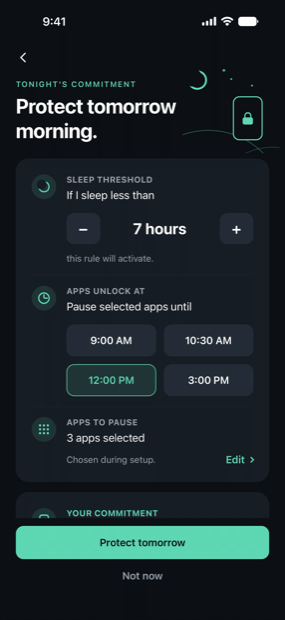
You set a minimum sleep, a time the apps come back regardless, and which apps are affected. Reclaim isn't enforcing a health verdict — it's enforcing the decision you already made, against the you who'll renegotiate at 7am.

Tonight's commitment screen: sleep threshold set to 7 hours, apps unlock at 12:00 PM, 3 apps selected
Tonight's commitment
07:12

Your watch already knew. It just never did anything.

Apple Watch, WHOOP and Oura all write sleep into Apple Health. Reclaim reads last night once and merges overlapping records. Total duration only — no HRV, no proprietary recovery score.

07:14

The apps you chose stay closed.

iOS Screen Time blocks them for real — you get the shield, not a notification you can swipe away. It says what happened in numbers, never what it thinks of you.

When Health has nothing Apple Health has nothing for last night, so the commitment stands. "Unlock anyway" is there if you need it.
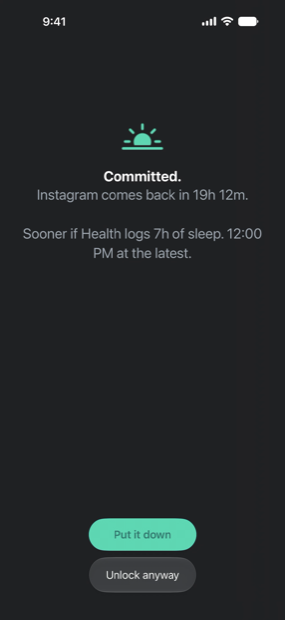
The overnight shield: Committed. Instagram comes back in 19h 12m. Two buttons, Put it down and Unlock anyway
The overnight shield
ANY TIME

The door is never locked.

Every shield carries a second button that genuinely lifts the block — one tap, no confirmation, no guilt copy. Reclaim logs the override instead of preventing it.

Pause all rules
One tap kills every block and clears the commitment.
You can always fire the app.
You pick the apps
Nothing is blocked until you choose it. Essential apps stay untouchable.
The line between supportive and controlling.
Night context tags
Mark a night as illness, travel, caring for someone, a late shift.
A flu week must not read as a failing.
64% abandoned a hard-lockout blocker inside five weeks. Adaptive friction kept 62% — and worked about 16% better. Lu & Guo, CHI 2024, n=42
4 NIGHTS

Sometimes the right move is to switch itself off.

Stand-down

If your last four nights each came in under five hours, the shield comes down and stays down. At that level of sleep loss, the copy points at a doctor, not a habit.

Four nights · example

07:30

Twenty minutes that don't buy you anything.

Instead of the feed: a guided 4-4-6 breathing round, or a 20-minute walk timer. Taking one does not unlock a single app — the block stands either way. A reset that buys entry stops being an offer and starts being a toll.

12:00

The block lifts whether you earned it or not.

The unlock time is part of the commitment, so no morning ends with your phone still holding something back. On a blocked morning Reclaim shows how many times you reached for a paused app — a number, with no comment attached.

DAY 13

What thirteen mornings are allowed to tell you.

Patterns come from your own records, and only appear once there's enough evidence behind them.

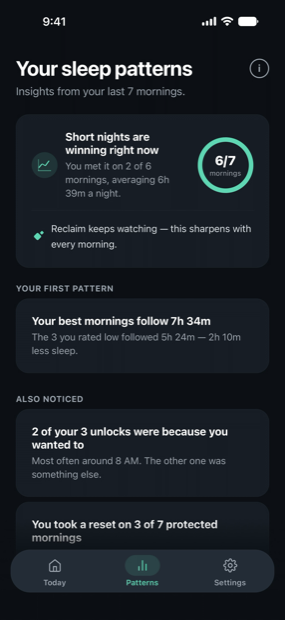
Your best mornings follow 7h 34m
The mornings you unlock, you've already reached 6 times
You met your goal on 2 of 6 mornings, averaging 6h 39m
The patterns screen showing insights from the last 7 mornings
Patterns, after 7 mornings

The sensors already shipped. The data just ends at a chart.

46%

of US adults own a wearable. 13% in 2015.

Rock Health, n=8,000, 2026
g = 0.89

State-triggered interventions vs non-adaptive. Reclaim is one.

Wang & Miller 2020 · 21 of the 33 studies
Nobody

gates on verified sleep data.

Screen Time · Opal · Freedom · Brick — all fixed schedules

A timing advantage, not a moat — and we say so.

Local, boring, and honest about its edges.

No account

No sign-up, no backend, no sync. Storage is on the device.

No network

The app makes no network calls at all.

Health, not APIs

One local read covers Watch, WHOOP and Oura. No OAuth.

iPhone only

Android's controls target managed devices. Different product.

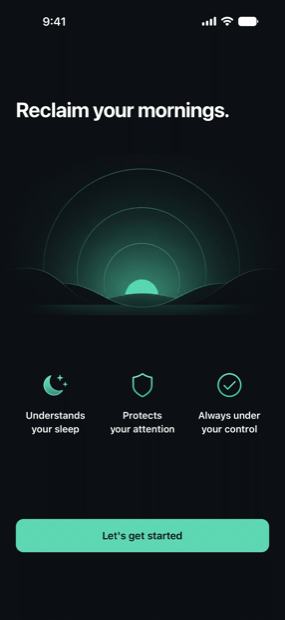
Reclaim's first-run screen: Reclaim your mornings, with three promises — understands your sleep, protects your attention, always under your control
First run

Reclaim doesn't tell you your body is unhealthy. It tells you today's data triggered the rule you wrote last night.

The full loop runs on device today. One disclosure: the Screen Time plumbing comes from our previous app — the health-triggered rule engine, the patterns and the product design are new.

Reclaim is on a handful of phones. Ask for the next build.

One email when the TestFlight opens, and nothing after it. iPhone, and a wearable that writes sleep to Apple Health.